
Big questions · Imagination
'Why Is the Sky Blue?' and the Other Endless Questions
The age of forty questions before breakfast.
October 1, 2026 · 3 min read
By the BananaBook team
In short: the sky is blue because sunlight contains all the colours, and blue is the one that scatters the most as it passes through the air (a phenomenon called Rayleigh scattering). That's why our eyes see blue all around us. In the evening, the light travels through more air: the blue is lost on the way, and the reds and oranges remain.
The age of forty questions before breakfast.
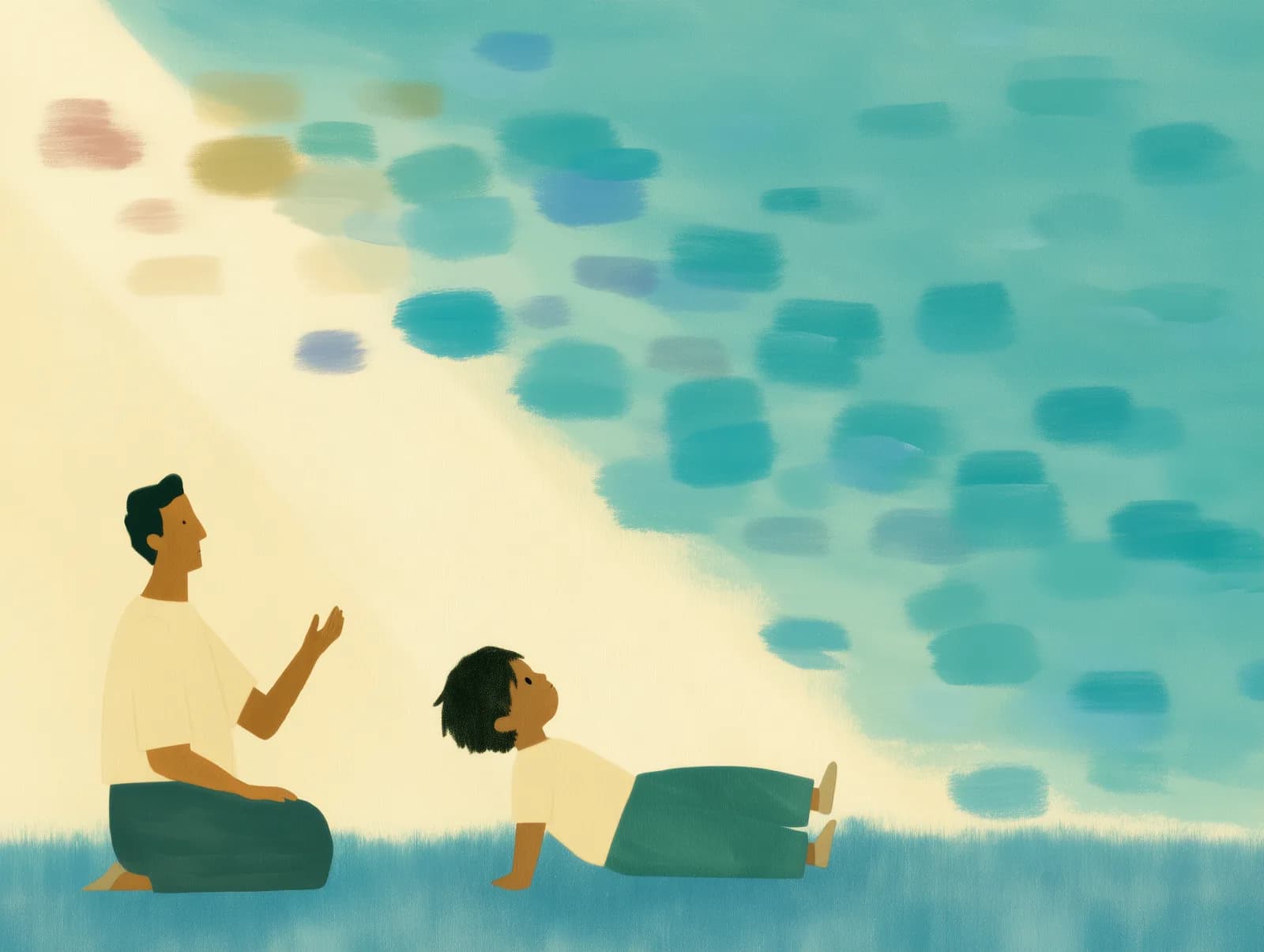
Around four, children discover that behind every answer hides another question. The sky is blue. Why? Because of the light. Why? Because of the air. Why?
It's exhausting. It's also exactly what a mind does at this age — and the way we answer often leaves a deeper mark than the answer itself.
"I don't know" is a better answer than it seems. Said calmly, it shows a child that not knowing is an ordinary state, not a failure. And "let's find out together" often goes further still: the question doesn't have to be settled on the spot, from memory. Looking it up as a pair may be the real answer.
Sometimes, handing the question back — "what do you think?" — opens more than the right answer does. A four-year-old's theory about the colour of the sky is often worth more, for their thinking, than being correct.
And "why is the sky blue?" is sometimes about the light, and sometimes about something else entirely: will you keep talking to me? The second may matter more.
The "whys" eventually slow down. What remains is whether curiosity was welcomed as a gift, or endured as a chore. And sometimes, a good question deserves to become a story — which is the idea behind [Why Is the Sky Blue?](→ book link), where the child imagines every possible colour before discovering the real answer, never losing the wonder.
Frequently asked questions
Why is the sky blue?
Because sunlight contains all the colours, and blue scatters the most as it passes through the air (Rayleigh scattering). So our eyes see blue all around.
Why does the sky turn red or orange in the evening?
At sunset, the light travels through much more air: the blue is lost along the way, and only the reds and oranges remain.
Why is the sky black at night?
Because the sun has moved to the other side of the Earth: with no light to scatter, the sky turns black and reveals the stars.
What do you say when you don't know the answer?
"I don't know — shall we find out together?" is often the loveliest answer: it turns not knowing into the start of a discovery.
More from the Journal
Big questions
Is Father Christmas Real? How to Answer Your Child
Your child is starting to doubt Father Christmas? How to answer with honesty, without lying and without breaking the magic — a gentle approach for parents.
1 related story Read
Sleep
When the Nightmares Keep Coming Back
Awake at 3 a.m., the same dream again.
1 related story Read
Big milestones
The First Milk Tooth Starts to Wobble
Half excitement, half worry.
1 related story Read